.avif)

TL;DR
- An effective AI security approach includes four core practices: discover, detect, govern, and prevent.
- AI-driven attacks are increasing due to a lack of basic security guardrails and controls.
- The enterprise AI attack surface is expanding as AI becomes more autonomous.
- The goal isn't to block AI adoption. It’s to help organizations gain control across their AI ecosystem.
Why AI Security Needs Its Own Playbook
Traditional application security assumes IT approves software before anyone uses it. AI adoption breaks this assumption: employees adopt new AI tools without IT knowing, developers rely on AI to build applications, and AI agents are becoming more autonomous, even taking actions without human intervention.
The result is a growing attack surface that looks less like managed software and more like AI sprawl – the uncontrolled proliferation of AI tools, agents, and AI-enabled workflows across the business.
In addition, existing application security tools weren’t designed to address AI-specific risks and are insufficient for securing enterprise AI.
All this requires a different approach to AI security.
These four AI security best practices, discover, detect, govern, and prevent, help organizations gain visibility into AI usage, monitor activity, ensure regulatory compliance, and proactively mitigate and remediate risks across the enterprise AI environment. Organizations can’t prevent threats they aren’t detecting, and they can’t govern AI they haven’t discovered.
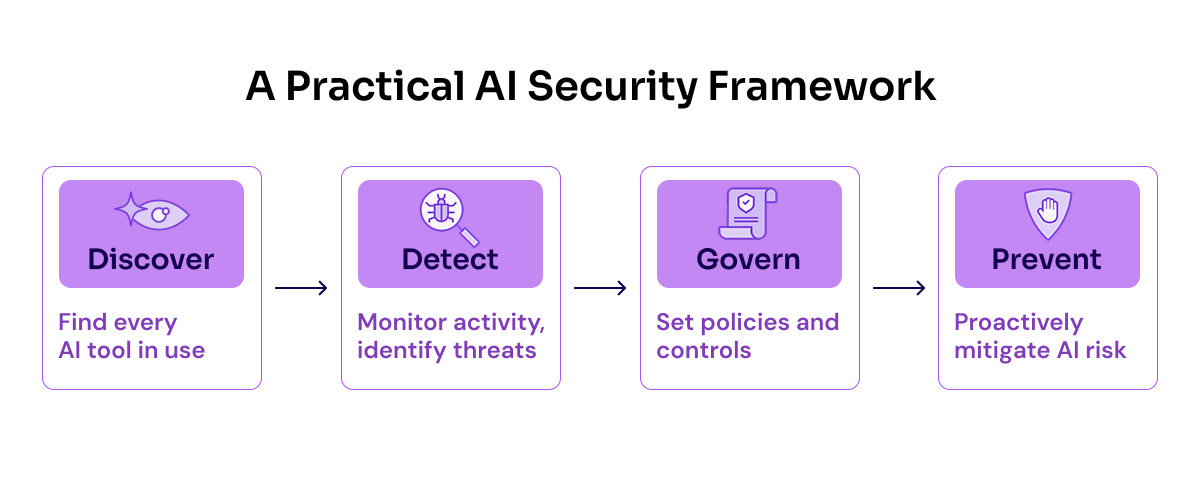
1. Discover: Build a Real Inventory of AI Usage
Effective AI security starts with understanding what's really happening across the organization, not just what's officially approved. Begin by identifying public GenAI tools employees access through both business and personal accounts, homegrown AI apps, and coding assistants.
Run continuous, automated AI inventory discovery. New AI applications, models, and features appear constantly, making point-in-time assessments outdated almost immediately.
Discovery should cover all directions of exposure:
- Public GenAI tools
- Homegrown AI apps
- Coding assistants
- AI agents
- Agent skills
- MCP servers
- Embedded AI tools
Without complete visibility into all AI tools, usage, interactions, and interfaces in the AI environment, security controls will remain incomplete.
2. Detect: Monitor Usage Continuously
Once organizations know what AI exists, they need to understand how it's being used. Ongoing monitoring helps security teams identify malicious inputs, unauthorized access, policy violations, and unusual activity before they turn into security incidents.
Unlike traditional applications, AI usage changes daily as employees adopt new tools, developers deploy AI-enabled applications, and vendors introduce new capabilities. Continuous detection is the only practical way to maintain an accurate understanding of organizational AI risk.
Detection should extend beyond user prompts, identifying malicious data inputs and unauthorized access in real time, as well as pinpointing vulnerabilities, compliance gaps, and anomalies that threaten the organization’s AI assets.
3. Govern: Establish Clear Policies and Controls
Strong AI governance keeps the organization secure and compliant, allowing teams to innovate with AI confidently and at scale. Create a fast approval process for AI usage. If employees can obtain approved AI solutions quickly, they're far less likely to seek unauthorized alternatives.
Governance should apply consistently across public AI tools, homegrown AI applications, AI agents, and coding assistants. Finally, governance should also produce audit-ready evidence showing how AI is being used, where sensitive data is flowing, and whether organizational policies are being enforced.
4. Prevent: Proactively Mitigate and Remediate Risks
The strongest AI security practices focus on preventing incidents rather than simply responding after the fact.
Effective prevention combines ongoing, automated, and real-time policy enforcement. Organizations should be able to proactively mitigate and remediate risks with advanced threat protection and built-in safeguards to protect AI applications, models, data, and systems from exploitation.
The objective isn't to restrict AI adoption. It's to make secure AI innovation the easiest path for employees.
Putting It Together: What Good AI Security Looks Like in Practice
Why Organizations Need AI Security Now
Gartner predicts that by 2030, more than 40% of enterprises will experience a security or compliance incident linked to unauthorized shadow AI. Statista forecasts that the number of active AI agents in enterprises worldwide will grow from 28.6 million in 2025 to more than 2.2 billion by 2030. And according to IBM, 77% of organizations say AI adoption is already outpacing their current governance capabilities.
Together, these trends show how rapidly AI adoption and the enterprise AI attack surface are expanding. Employees continue to adopt unauthorized AI tools without waiting for IT approval, while organizations deploy growing numbers of AI agents capable of accessing data, connecting to business systems, and taking actions autonomously.
Organizations that don’t apply an effective AI security strategy will be left behind, turning today’s visibility problem into tomorrow’s security and compliance challenge. Organizations that establish the four practices above will be better positioned to adopt AI safely and prepare themselves for the autonomous AI era.
FAQ
The four core AI security practices are discover, detect, govern, and prevent. Together, they help organizations gain visibility into AI usage, monitor activity, enforce policies, and proactively mitigate and remediate risks, enabling them to secure their entire AI ecosystem.
AI adoption often happens outside IT approval processes, so security teams need a way to understand what's really happening across the organization. On top of that, traditional application security tools weren’t designed to address AI-specific risks and are insufficient for securing enterprise AI.
An AI inventory is a map of an organization’s AI assets. It should provide a comprehensive view of the entire AI landscape, from public GenAI tools, homegrown AI apps, coding assistants, and AI agents to MCP servers and embedded AI tools.
Organizations can use automated policy enforcement, real-time controls, advanced threat protection, and built-in safeguards to prevent data leakage, block malicious activity, enforce secure AI usage, and automate remediation.
Good AI security combines continuous discovery, ongoing monitoring, clear governance, and real-time prevention. It gives organizations visibility into AI usage, helps identify risks and policy violations, enforces controls consistently, and prevents incidents before they occur.
As AI adoption accelerates, the enterprise AI attack surface continues to expand. Organizations that establish visibility, continuous monitoring, governance, and preventive controls will be better positioned to adopt AI safely and prepare for the autonomous AI era.

.avif)